Fraud protection.
Now it's personal.
ANZ Falcon® technology monitors millions of transactions every day to help keep you safe from fraud.
Falcon® is a registered trademark of Fair Issac Corporation.


Fraud protection.
Now it's personal.
ANZ Falcon® technology monitors millions of transactions every day to help keep you safe from fraud.
Falcon® is a registered trademark of Fair Issac Corporation.

Fraud protection.
Now it's personal.
ANZ Falcon® technology monitors millions of transactions every day to help keep you safe from fraud.
Falcon® is a registered trademark of Fair Issac Corporation.
Social and environmental risks arising from transactions, projects and customer relationships can affect society, human rights, associated communities and the environment. Through our engagement with our large business customers, we seek to identify and understand social and environmental risks posed by their activities and to understand how these are being managed by the customer.
We regularly review our existing lending practices and policies to ensure there is adequate consideration of current and emerging social and environmental issues.

ANZ’s Social and Environmental Risk Policy and Standard applies to ANZ’s banking business, excluding Suncorp Bank, which currently operates under a separate authorised deposit-taking institution (ADI) licence.
On 31 July 2024, ANZ acquired 100% of the shares in SBGH Limited, the immediate holding company of Suncorp Bank. Following the acquisition, Suncorp Bank commenced a phased transition to adopt the policies and processes of ANZ. During the transition period Suncorp Bank will be subject to a combination of ANZ and Suncorp Bank policies. ANZ’s Social and Environmental Risk Policy and Standard do not currently apply to Suncorp Bank.
Our social and environmental risk screening tool facilitates qualitative assessments of social and environmental risks, that may result in potential financial and/or non-financial risks to ANZ Bank Group. It also assists bankers in the application of the S&E Risk Policy and the S&E Risk Standard.
This assessment is ordinarily performed2 when conducting due diligence on new-to-bank customers, when reviewing existing customers (at least annually), prior to a material transaction, or when ANZ Bank Group becomes aware of a material change to the customer’s activities, or a material impact3 occurring. Where a material issue is identified, ANZ will seek to use our leverage and work with our customers to understand the circumstances and, where appropriate, encourage them to identify a specific, time-bound improvement or remediation plan. ANZ may decline further financing or exit the relationship if the customer is not willing to commit to an improvement or remediation plan.
Our Climate Risk Standard provides detail on internal requirements for managing climate risk for each of our customer facing divisions, including in accordance with our S&E Risk Policy.
Relevant employees are educated about our Social and Environmental Risk Policy and the Social and Environmental Risk Standard, including specific requirements for ‘sensitive sectors’.
Educating relevant employees on our policies and standards, and how they are applied in practice, is important for the effective management of the social and environmental risks when considering our large business customers’ transactions and relationships.
Our training focuses on the Policy and Standard, including our approach to human rights. This training is mandatory for new employees authorised to make credit decisions relating to large business customers. Guidance is also provided on how to identify and escalate potential issues to business and risk leaders.
In addition to our internal education, we also provide briefings to customers on our social and environmental risk management and how our approach may impact the products and services we offer.

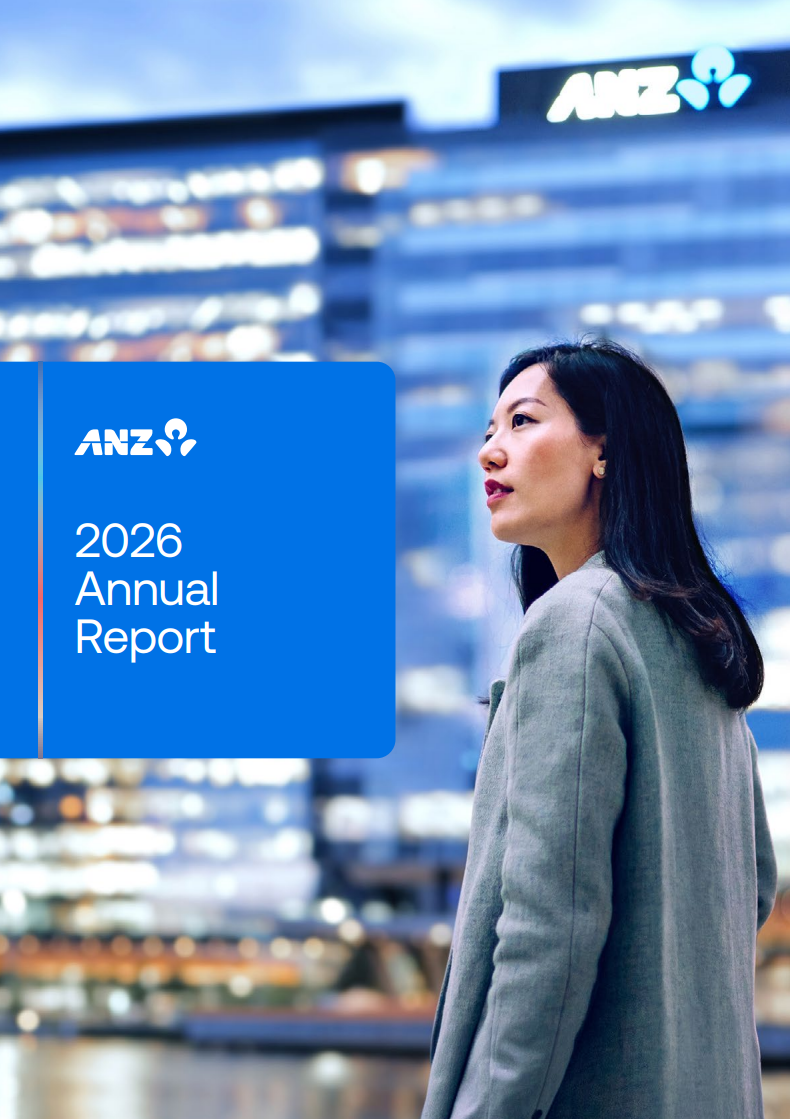
The Annual Report descibes how we are aiming to create value for our stakeholders. This year, ANZ has integrated sustainability disclosures and mandatory climate disclosures into the Annual Report. Released 9 November 2026.
1. Large business customers are customers of ANZ’s Institutional division where ANZ has a credit exposure.
2. A new screening is not required if an assessment has been completed within the previous 3 months, unless new information becomes available that ANZ considers may materially and adversely change the earlier assessment.
3. In this context, a material issue may relate to an adverse political, social (including human rights), environmental or economic impact of a customer’s activities or proposed activities that ANZ identifies is material in nature.